Fire and life safety
Fire extinguisher
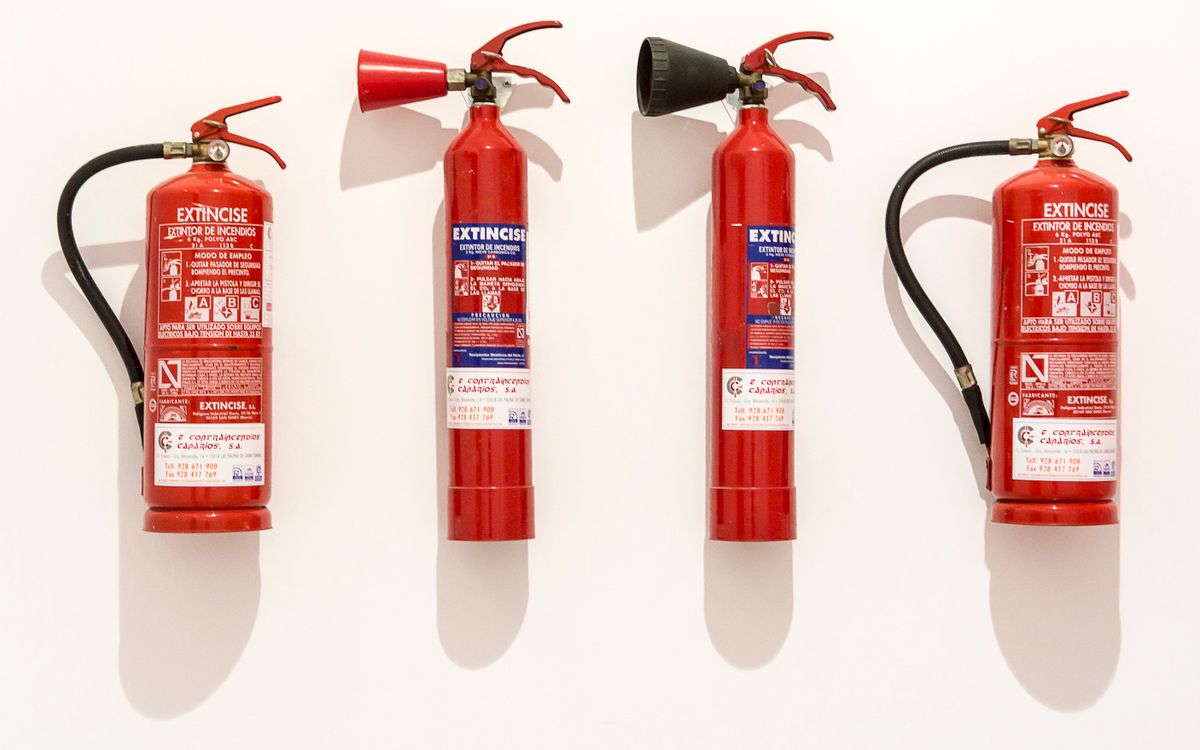
A fire extinguisher is equipment in the fire and life safety category. Portable pressurised units requiring periodic inspection, annual maintenance, internal examination, and hydrostatic testing.
Also called: portable fire extinguisher, extinguisher, ABC extinguisher, dry chemical extinguisher.
Governing standards
NFPA 10
Standard for Portable Fire Extinguishers
Selection, installation, inspection, maintenance, recharging, and testing of portable fire extinguishers.
Issued by National Fire Protection Association
OSHA 1910.157
Portable Fire Extinguishers
Employer requirements for placement, use, maintenance, and testing of portable fire extinguishers in the workplace.
Issued by Occupational Safety and Health Administration
Required artifacts
| Artifact | What it does |
|---|---|
| Inspection tag | An inspection tag is a compliance consumable affixed to equipment that records who serviced it, when, and under what licence. |
| Verification collar | A verification collar is a compliance consumable seated between a valve and a cylinder neck that records internal maintenance and cannot be removed without discharging the unit. |
| Service label | A service label is a compliance consumable applied directly to equipment recording a test, a certification, or a next-due date. |
Which of these you actually need, and on what cycle, depends on your jurisdiction. We publish that only where we have read the governing clause and can cite it. Where we have not, the page says so rather than guessing.
In stock for fire extinguishers
Fire extinguisher inspection tag, card stock
The standard annual service tag. Twelve month punch grid, imprint area for company name, licence line, and technician initials.
$0.35 per unit at 100
Fire extinguisher inspection tag, UV plastic
For units mounted outdoors or in wash-down areas where card stock will not survive twelve months.
$0.99 per unit at 100
Six year maintenance verification collar
Seats between valve and cylinder. It cannot be removed without discharging the unit, which is the entire point of it.
$0.31 per unit at 100
What it is
A pressurised cylinder holding a suppressant - dry chemical in most buildings, CO2 near electronics, wet chemical in kitchens - with a gauge, a pull pin and a discharge hose. Wall mounted or on a stand, usually within seventy five feet of anywhere a person works.
Why it gets inspected
Pressure leaks slowly and invisibly. A unit can sit for a year looking perfect and be at half charge, and the first anyone knows is when it will not discharge. Dry chemical also packs down into a solid cake if the cylinder is never inverted, so a gauge in the green is not on its own proof the unit works.
What happens on a visit
Check the gauge, the seal and the pin, look for corrosion or a blocked nozzle, heft it to confirm it is still full, confirm nothing is stacked in front of it, then initial the tag. Roughly ninety seconds a unit once you have a route.
What drives the tag count
Route density is what drives the tag count, not the customer count: a single mid-rise can carry forty units while ten small retail units carry one each. Count devices, not sites. The other number people miss is the six year population - internal maintenance falls due on a different clock to the annual, so collars are ordered against a fraction of the tag quantity.
What actually gets tagged, and where it goes
One extinguisher carries more than one artifact and they are not interchangeable. The inspection tag hangs from the neck or the pull pin and is replaced at the annual service, so it is the item consumed fastest. The maintenance collar sits around the neck under the valve and is fitted at the internal examination, which is a multi-year event, so it is bought in far smaller quantities and has to survive far longer. Some operations add a small void label to the cylinder or a barcode to the bracket for location. The practical consequence for an order is that tags and collars are ordered on completely different rhythms, and buying them in the same ratio is the most common mistake on a first order.
What a scan of fire extinguishers shows
A scan resolves to that individual extinguisher: where it is mounted, its type and size, when it was last serviced and what is due next. The failure it prevents is specific to extinguishers, which move. A unit taken away for recharge and returned to a different floor becomes, on paper, a missing extinguisher in one location and an unexpected one in another. Because the record follows the serial rather than the position, the unit is still itself wherever it ends up, and its service history goes with it.
Every artifact here is serialised, so the record survives the tag being replaced. The mechanics are on how inspection records work.
Sizing an order for a fleet of fire extinguishers
Count mounted units, not buildings. A tag per extinguisher per year is the baseline, then add roughly five per cent for units damaged in service and tags spoiled during filling. Collars are ordered against the number of extinguishers actually reaching their internal examination in that year, which is normally a small fraction of the fleet, so ordering collars at tag quantities means paying for stock that expires in a drawer. If you are unsure of the fleet count, the hundred unit minimum covers a small commercial building outright and is the cheapest way to find out how the substrate performs in your buildings before committing.
Minimum is 100 units and every price is on the page, so a first order can be a test rather than a commitment. Why the minimum is 100, not 2,500.
Inspected on the same visit
An extinguisher round rarely happens alone. The technician walking a building for extinguishers is usually the same visit that reaches the kitchen hood suppression system, and in many contracts the fire alarm panel service is scheduled to coincide so the building is disturbed once rather than three times. Eyewash stations get picked up on the same walk in industrial buildings because they are on the same route and nobody wants a second trip for a weekly activation. Ordering these together matters commercially: they share your imprint, ship as one consignment, and the unit price on a combined order is meaningfully better than four separate ones.
Ordering fire extinguishers: common questions
How many tags do I need per extinguisher per year?
One inspection tag per extinguisher per year, plus roughly five per cent for units damaged in service and tags spoiled during filling. Collars are different: they are fitted at the internal examination, which is a multi-year event, so you order them against the number of extinguishers actually reaching that milestone in the year rather than against the whole fleet. Ordering collars at tag quantities is the most common first-order mistake.
Can I use the same tag design across every client I service?
Yes, and most servicing companies do. The imprint carries your company name, licence line and phone, not the client details, because the tag identifies who performed the service. One imprint covers every building on your route, which is what makes a single larger order cheaper per unit than repeated small ones.
What happens if an extinguisher moves to a different building?
Nothing breaks. The record follows the serial rather than the location, so a unit taken away for recharge and returned to a different floor is still itself, with its service history attached. This is the specific failure serialisation solves for extinguishers, which move more than most fixed equipment.