Fire and life safety
Standpipe
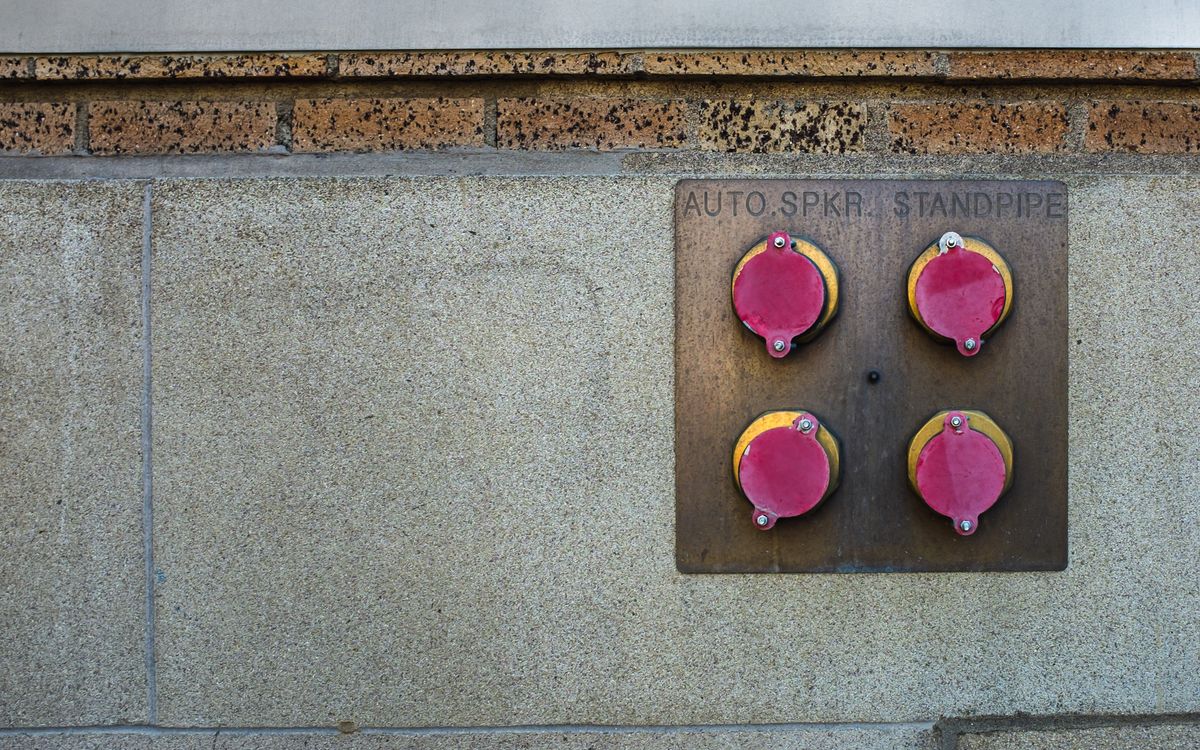
A standpipe is equipment in the fire and life safety category. Piping delivering water to hose connections throughout a building, inspected and flow tested on a cycle.
Also called: fire standpipe, hose connection, fire department connection, FDC.
Governing standards
Required artifacts
| Artifact | What it does |
|---|---|
| Inspection tag | An inspection tag is a compliance consumable affixed to equipment that records who serviced it, when, and under what licence. |
| Placard | A placard is a compliance consumable displayed at equipment or on a premises to satisfy a posting requirement. |
Which of these you actually need, and on what cycle, depends on your jurisdiction. We publish that only where we have read the governing clause and can cite it. Where we have not, the page says so rather than guessing.
In stock for standpipes
What it is
A dry or wet vertical pipe running the height of a building with hose valves at each floor, fed by a fire department connection at street level. It is how a crew gets water to the twentieth floor without dragging hose up twenty flights.
Why it gets inspected
Standpipes fail quietly because nobody uses them between emergencies. Caps go missing, threads corrode, valves seize, and the FDC gets painted over or parked in front of. Every one of those is discovered at the worst possible moment.
What happens on a visit
Walk every floor valve, check caps and threads, confirm the FDC is unobstructed and its caps are in place, and verify the identification plate still says what the connection actually serves.
What drives the tag count
Inspected largely for accessibility and the physical condition of hose connections and caps, with flow testing on a much longer cycle. It is routinely confused with a riser because both are vertical pipe under the same standard, but the inspection content is different.
What actually gets tagged, and where it goes
Standpipe artifacts attach at the hose valve or the outlet, which is the point an inspector actually looks at, and they have to survive a stairwell or an exterior wall. Where a building has outlets on every floor, each outlet is tagged rather than the system as a whole, because the inspection is per outlet and a system level tag cannot show that the fourteenth floor was reached. Exterior fire department connections take the harshest exposure of any tag in a building and should be specified in plastic without exception.
What a scan of standpipes shows
The characteristic standpipe failure is not a system that was never inspected, it is a system where somebody inspected the accessible outlets and the record does not distinguish those from the ones they did not reach. Per outlet records make that visible: an outlet with a stale date stands out instead of being averaged into a building that reads as current. For a building owner, that is the difference between a report that says the standpipe was inspected and a record that shows which parts of it were.
Every artifact here is serialised, so the record survives the tag being replaced. The mechanics are on how inspection records work.
Sizing an order for a fleet of standpipes
Count outlets, then add the fire department connections. A tall building consumes far more standpipe tags than its floor count suggests because outlets appear in multiple stairwells per floor. Order per outlet for a full annual cycle and specify plastic for anything exterior or in an unheated stair, since replacing a handful of illegible exterior tags mid-year costs more in trips than specifying correctly at the start.
Minimum is 100 units and every price is on the page, so a first order can be a test rather than a commitment. Why the minimum is 100, not 2,500.
Inspected on the same visit
Standpipe outlets are almost never inspected in isolation. The stairwell walk that reaches every outlet is the same walk that reaches the extinguishers on each landing, and the visit that covers the standpipe normally covers the sprinkler riser and fire pump feeding the same system. Because the outlet count in a tall building is high and the extinguisher count on the same route is higher, these two dominate the order quantity while the riser and pump contribute only a handful each.
Ordering standpipes: common questions
Do I need a tag at every outlet?
Per outlet is the only arrangement that shows which parts of the system were actually reached. A system-level record cannot distinguish an inspector who checked every floor from one who checked the accessible ones, and that distinction is the whole question a standpipe record answers.
What substrate for exterior fire department connections?
Plastic, without exception. Exterior connections take the harshest exposure of any tag in a building, and replacing a handful of illegible exterior tags mid-year costs more in trips than specifying correctly at the start. Interior stairwell outlets can take card if the stair is heated and dry.
How do I estimate quantity for a tall building?
Count outlets rather than floors. Outlets frequently appear in multiple stairwells per floor, so a tall building consumes considerably more than its floor count suggests. Then add the fire department connections, which are easy to forget because they are outside.